
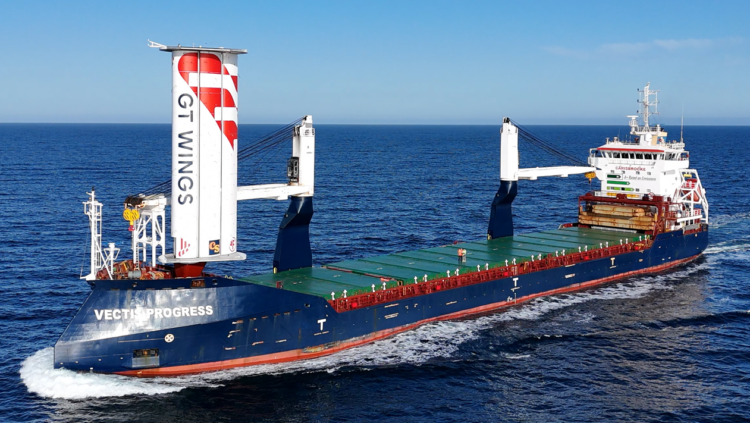
Is it a ship… or a plane? It’s a ship with wings
Liverpool city region venture employs the principle of aircraft wings to power commercial vessels with wind in a ‘back to the future’ innovation that aims to slash shipping emissions. Tony McDonough reports

There was a time when the River Mersey teemed with sail-powered vessels.
However, the development of steam engines in ships throughout the 19th century – and later diesel-driven engines – consigned the age of commercial sail to nostalgic paintings in art galleries. Until now.
Today, humanity is in the process of re-engineering how we produce energy. The fossil fuels that drove the Industrial Revolution are being phased out as we race against time to limit the effects of climate change caused by CO2 emissions.
Marine diesel – traditionally known as bunker fuel – is not only the cause of CO2 emissions but is also particularly filthy, spewing out the most toxic of fumes. It is a real environmental hazard particularly in port when vessels are close to people.
Shipping’s contribution to human CO2 emissions is relatively small – around 2% of the total. Nevertheless the maritime sector has fully committed to decarbonisation, no mean feat. The main focus has been on electric or alternative fuels.
However, one Liverpool city region venture is going ‘back to the future’ to use the power of wind to once more propel commercial vessels across the oceans.
GT Green Technologies, using the brand GT Wings, has secured £150,000 from the £750,000 LCR Freeport Innovation Challenge Fund. It has previously secured Government decarbonisation funding.
This cash injection will be used by GT Wings to invest in composite tooling to scale production of its ‘Jet Sail’ wind propulsion system called ‘AirWing’ which can cut fuel use and emissions from cargo ships by up to 30%.
Aircraft wings use air flow to generate lift. GT Wings ‘wings’, once fitted upright to a ship and rising to 20 metres, operate on the same principle but instead use the wind to generate thrust. This allows vessels to reduce power, saving fuel and cutting emissions.
A 20-metre prototype has been fitted to Vectis Progress, a cargo vessel owned by Carisbrooke Shipping and chartered by Fednav on the vessel’s forecastle deck (at the front). This retrofit has delivered reductions in fuel consumption and emissions.
At a 2025 event organised by Mersey Maritime, GT Wings product director Martin Harrop said: “What we do slightly differently is that we are in the area of large -trans ocean – bigger cargo vessels where other technologies struggle.
“Wind is a zero emission energy source at the point of use. Our wings can generate significant thrust from a smaller area than our competitors.
“On average, we expect to achieve around 10% fuel savings over the course of a year—but in favourable wind conditions, savings could reach up to 30%
“We are now looking for a home to do the assembly and installation work. Liverpool would be a fantastic place for that because of its positioning in terms of Transatlantic shipping routes.”
Alongside the LCR Freeport Innovation Challenge Fund is the CR Freeport Skills Infrastructure Grant, also worth £250,000. In the last few weeks nine projects, including GT Wings, have secured grants from both pots.
Stanlow Terminals will receive £250,000 for its CO2 non-pipeline transfer (NPT) import terminal linked to early-stage infrastructure design to enable import, storage and onward transport of captured carbon dioxide at Stanlow and Tranmere.
Liverpool John Moores University and Peel Ports have also received funding from the LCR Freeport Innovation Challenge Fund.
READ MORE: Profits rise 10% to £47.4m at Stanlow Terminals
Hugh Baird College is one of five recipients of funding through the LCR Freeport Skills Infrastructure Grant, and will use £135,000 for a Freight Simulation Suite, creating a digital logistics training hub.
The University of Liverpool, Riverside College, St. Helens College and the Wirral Met College also received LCR Freeport Skills Infrastructure Grant funding.
Mersey Maritime chief executive Ruth Wood added: “Mersey Maritime is committed to tackling the sector’s key priorities: innovation, digitalisation, and developing future skills.
“The LCR Freeport Innovation Challenge Fund offers a significant opportunity with real financial backing, to accelerate this agenda.
“That’s why we were eager to support this initiative, which empowers businesses driving practical change in maritime.”
Comments are closed.