
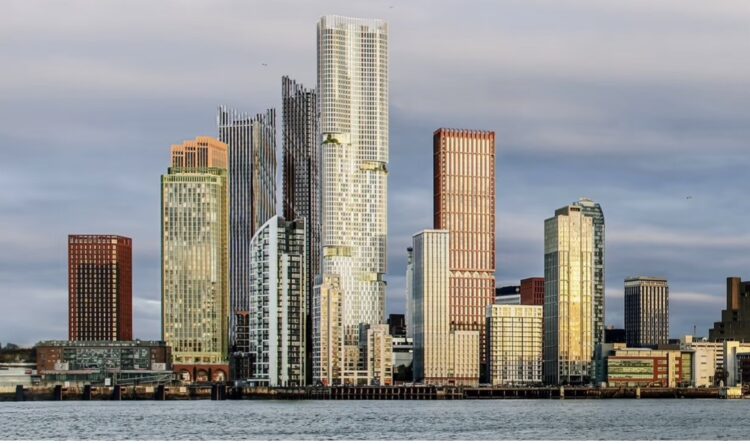
Costing £1.2bn the mammoth Kings development will create a skyscraper cluster close to Liverpool waterfront, including a 70-storey tower… developer Hugh Frost tells LBN when it will start and finish, who is paying – and much more. Tony McDonough reports

Hugh Frost knows a thing or two about pioneering developments in Liverpool, investing in high-end city centre living as long ago as the 1990s.
His first scheme was Beetham Plaza, just off The Strand, and this was followed up by two high-rise residential schemes in Old Hall Street – Beetham Tower, rising to 30 storeys, and West Tower which is 40 storeys and includes the still popular Panoramic restaurant.
However, as ambitious as those projects were two decades ago, his latest endeavour is on a whole different level. As chairman of Beetham Davos he is overseeing the £1.2bn Kings development.
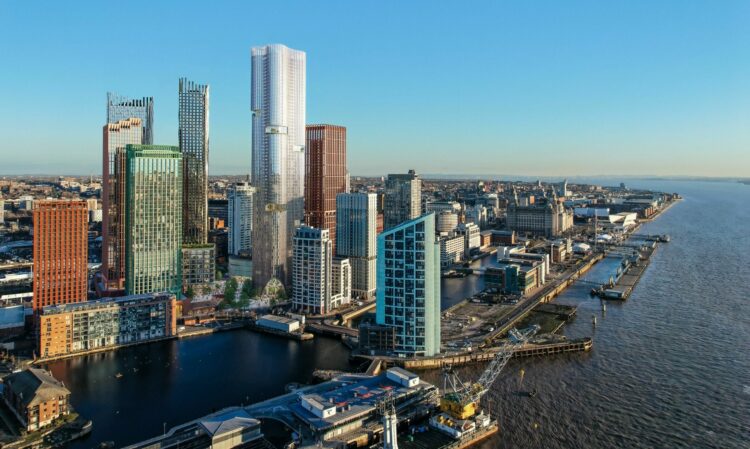
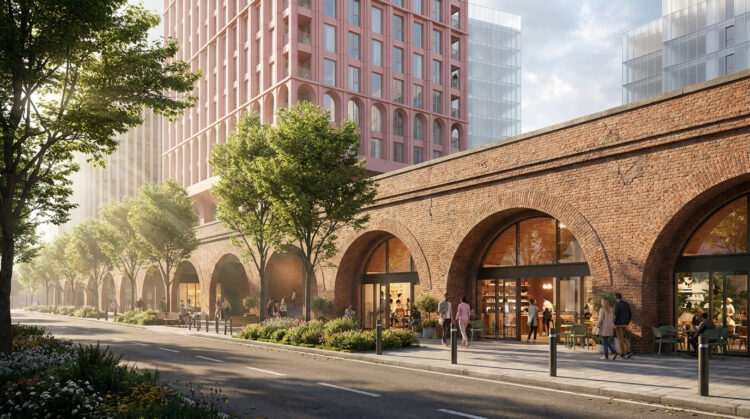
Planned for what is currently the King Edward Industrial Estate, sandwiched between the commercial district and Peel’s Prince’s Dock at Liverpool Waters, Kings is a development that dwarfs anything that has come before it – even Liverpool ONE.
Backed by Home Bargains billionaire Tom Morris, via his KEIE entity, Kings will feature 10 high-rise residential towers with a spectacular 70-storey structure that will include a five-star hotel and luxury apartments. It will be the tallest building ever built in Liverpool by far.
The hotel will occupy the first 23 floors of the building, offering 212 rooms, with the balance taken up by 563 luxury residences. Guest and resident amenities would include bars, restaurants, gymnasiums, banqueting and meeting facilities and a rooftop terrace.
In all, the building would provide 924,000 sq ft of space, making it the second largest building by floor space in Liverpool, after its famous Tobacco Warehouse. It is being designed by SimpsonHaugh.
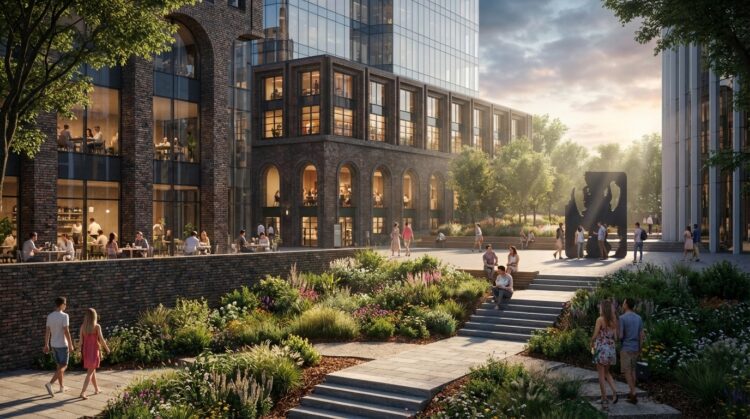
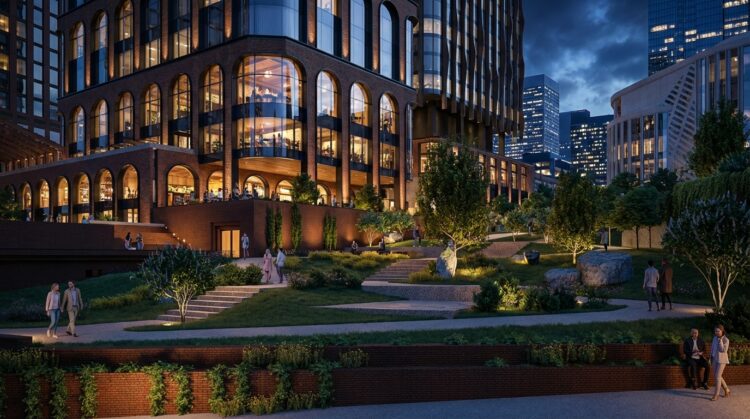
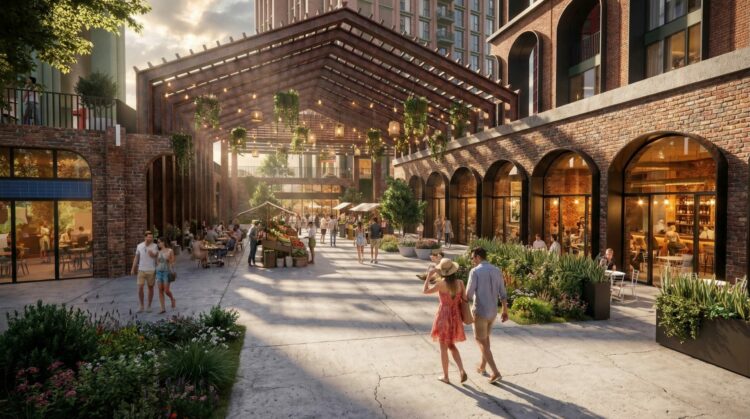
In total Kings, located on what is currently the King Edward Industrial Estate, will comprise 2,750 apartments, 200,000 sq ft of office space, a new 25,000 sq ft events arena and 250,000 sq ft of commercial leisure, retail, and food and beverage space.
Given the size and complexity of Kings it is no surprise to learn the development will be delivered over several years and will have to adapt to any changes in market demand for both residential and commercial space. So what is the timetable?
In an interview with LBN, Hugh Frost said there was a goal to have the whole thing built by 2035 – nine years from now. Site clearance is about to start but construction on the first building is likely to begin in the first half of 2027.
Called a ‘pathfinder’ development, this 28-storey tower is at the north end of the scheme on the site of a former Greek restaurant. The city council gave planning consent in February for the building which will offer 255 one, two and three-bedroom apartments.
“This will be a two-year build and will be completed by mid-2029,” said Hugh. “By that point we will have possession of the rest of the industrial estate and hopefully a masterplan approved by 2028.
“So we should be on site for the main development by 2030/31. Before mid-2029 we should be able to start work on the first buildings at the north end of the site because the industrial estate only goes up to Roberts Street.
“Currently we only have control of Greenock Street, the former Greek restaurant, the engineering works and the old King Edward Pub site.
“Over the next four months we will be able to clear that end of the site. The buildings earmarked for that can start late 2028, depending on planning permission. So optimistically you are looking at the whole site being finished by 2035.”
Centrepiece of Kings will, hopefully, be a tower that will rise to 70 storeys, way beyond anything ever built in Liverpool. Hugh is careful to say that 70 storeys is the ambition, short of a definite commitment.
And this is where market forces become a critical element of how the development progresses. During the past few years there has been huge demand for city centre living in Liverpool.
At the moment there is little sign of that changing but, with the construction of the bulk of the scheme still a few years away, it would be foolhardy for any developer to make a definite commitment.
That also goes for the commercial space and, in particular, the office space at the Pier Head end of Kings. Office space is already a thorny issue in Liverpool. There is a chronic shortage of grade A accommodation but relatively low headline rents are currently a disincentive to speculative builds.
“It is better to look at the masterplan as it emerges,” explained Hugh. “The biggest tower will take the best part of four years to build and will be in the final phase, starting maybe late 2031. That may or may not be 70 storeys but that is what we would like to achieve.
“Residential development is where the need is going to be because there is a housing shortage across the board. Even if this is top end it will free up other space that will meet that housing need.
“One of the first buildings in the phase after the initial pathfinder development will be rent-to-buy and shared ownership. So it becomes an accessible and inclusive development.
“Other buildings will probably be build-to-rent and will be market-led. You are not going to build anything that you can’t sell or rent.
“Office space will be market-led and the office space will be at the Pier Head end in the later phases unless we get a pre-let deal. There is a shortage of grade A space and this building will be very prominent so we will be searching for an anchor tenant.
“We will target law firms who are coming to the end of their existing leases. There is a big need for the city region to bring in employers to create proper jobs and more business density.”

With major developments, particularly on this scale, there is always an initial question over funding. Tom Morris’s involvement is eye-catching. Thanks to the success of Home Bargains his family’s fortune is estimated at around £6bn.
But he didn’t get that wealthy by investing on a whim. As Hugh points out, the masterplan will be delivered in stages and funding commitments will align with this. There is also the possibility of external funding partners.
“We haven’t decided yet on external development partners,” he added. “We have got Tom Morris committed to funding the first building – that will happen. He is committed to the site assembly and securing the masterplan consent. He will react to other interests that may come in.
“That diverse mix of tenures and uses is really important to the scheme. You have the hotel, residential, offices and residential with amenities such as restaurants, open space and some retail.”
Whenever LBN has posted stories about Kings on social media, a question that frequently crops up is “will it include affordable homes?”. To be classed as affordable the rent or sale price on a home needs to be no more than 80% of the local market rate.
Councils, including Liverpool, usually insist on 20% of new homes in a development are affordable. However developers can argue, and frequently do, that this provision could make their scheme unviable and can seek an exemption.
Hugh said: “At the moment they are doing viability tests on anything that is seeking consent. They assess whether it is viable for a developer to include a provision for affordable housing.
“Almost every test in Liverpool and almost across the country, including London, they aren’t sufficiently viable to pay for a percentage of affordable housing. That will change but we don’t know when and how much it will change.”
Beetham Davos aims to submit a masterplan to the city council by September and hopes to secure approval by mid-2027. This will be a mixture of outline planning and detailed. Hugh added: “Those that are outline will go to detail when we have a user.”
There is also the issue of the existing businesses on the industrial estate. Hugh said they won’t have to vacate their premises until mid-2029.
“It has always been an inappropriate use at this stage of the city’s evolution. We are sitting in the business district and you have those tired warehouses a stone’s throw away,” he explained.
“They are breaking the connectivity with what is happening at Liverpool Waters. So it has always needed to be redeveloped.”
Members of the public are now being invited to give their views on the project in a consultation exercise. You can take part by clicking here.
Brock Carmichael are the masterplan architects for Kings, with Pegasus Group providing planning, economics, heritage and EIA Services and Planit leading on public realm design. WSP is advising on highways.
According to Hugh, when he first started developing in Liverpool in the 1990s it was much easier, and less expensive, to secure planning consent.
“First development we did at the end of the 1990s was Beetham Plaza,” he said. “That was significant because it was modern city centre living and of decent quality for that time.
“In those days there were always the naysayers of course. When we bought Wilberforce House from the previous owners and put a planning application in, the reaction was ‘oh it should be pulled down, it is a dreadful building’.
“With the planning for the first building (Beetham Tower in Old Hall Street) we established that a high rise tower was appropriate.
“I think having a high rise in the city centre at that time was a new idea. One of the planners at the time loved tall buildings and the planning process in those days was much easier than it is today.”
READ MORE: Hospitality is alive and well… but needs a little support
In July 2021 Liverpool waterfront lost its World Heritage Status (WHS) following a stand-off between the city and UNESCO over the Everton stadium. While some lament the loss many in the business community felt it removed a major obstacle to urban renewal.
“The people involved in UNESCO would have had an issue with high rise buildings close to the prominent listed waterfront buildings… WHS status went and I don’t think it was to the detriment of the city,” reflected Hugh.
“I want this development to be very Liverpool-focused. One of our straplines is ‘Made for Liverpool, made for the world’. We want it to be part of a global city.”