
Analysis: In September Liverpool city region Mayor Steve Rotheram said there was ‘no magic wand’ to alleviate matchday congestion at Sandhills Merseyrail station… is he correct and what are the realistic options for improvement? Tony McDonough reports
Completion of Everton FC’s Hill Dickinson Stadium in Liverpool Waters in late 2024 was seen as a landmark moment for the regeneration of Liverpool’s northern docklands.
However, long before the project was finished there were warnings about the lack of transport infrastructure around the Bramley-Moore Dock site and the congestion seen on matchdays has prompted a lot of “told you sos” from Everton fans.
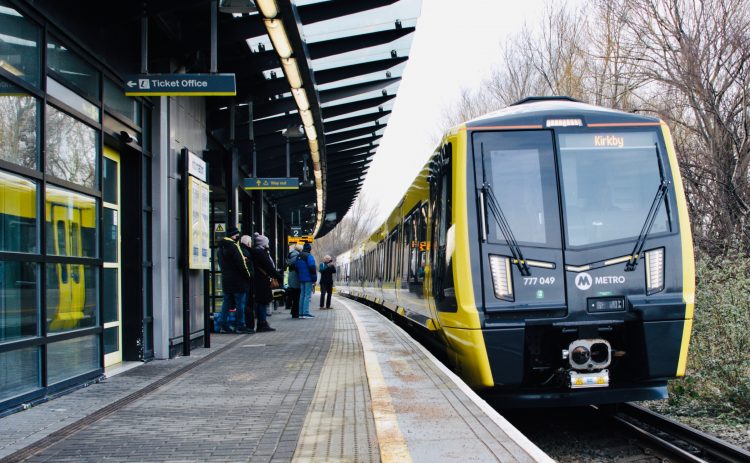
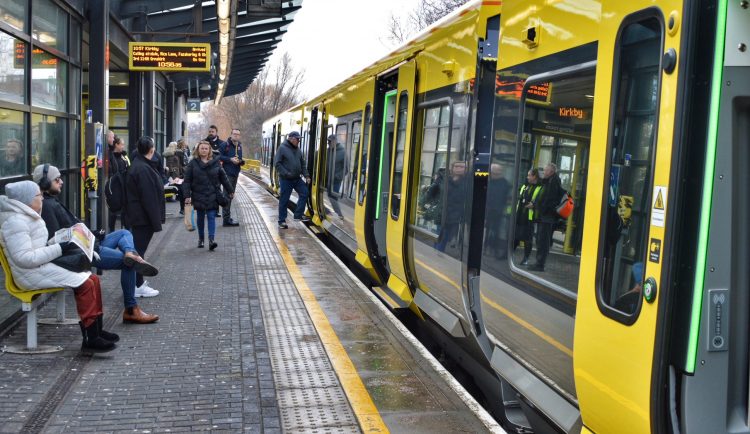
Their frustration has been primarily focused on Sandhills station, a key hub on the Merseyrail network which handles trains running on the northern line between the city centre, Kirkby, Ormskirk, Southport and Hunts Cross.
On a typical matchday around 11,000 passengers will travel to the stadium, which is a few minutes walk away from Sandhills, via train with numbers falling to between 6,000 and 8,000 after the match.
There is a general acceptance that 50,000-plus spectators leaving a football stadium all at the same time would cause congestion and delays in a built-up urban area, wherever it was in the world.
Sandhills also isn’t the only Merseyrail station within walking distance for the reasonably fit and able-bodied. Bank Hall on the Southport line isn’t too far away and Moorfields and James Street in the city centre are also reachable.
However, many Evertonians believe much more could be done to ease congestion at Sandhills both in terms of the handling of crowds at the station and more trains on the line.
In the last few weeks city region Mayor Steve Rotheram, who oversees the local transport authority (previously called Merseytravel), has said there is “no magic wand” to fully address the issues at Sandhills. So what are the options and how much would they cost?…
More capacity for passengers at Sandhills
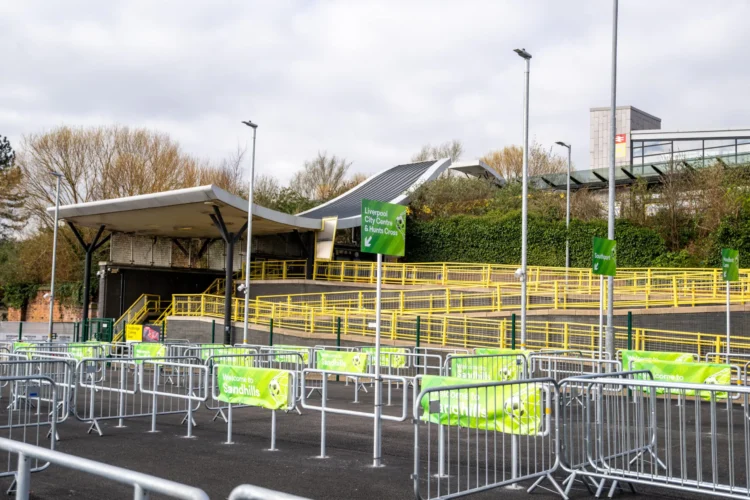
This is perhaps the easiest and cheapest part of the puzzle to solve. During the previous Premier League season a new footbridge was installed by contractor Morgan Sindall to cope with the thousands of fans each matchday as well as a crowd corralling area.
While this helped it quickly became clear that more improvements were necessary. In September, at the second attempt, Merseyrail persuaded Liverpool’s planning committee to approve plans to expand these facilities.
Proposals include an extension of the existing corralling area for destination specific queue routes. Merseyrail will also provide additional passenger welfare facilities, permanent toilet provision and an area for future potential catering services.
And there will be additional stair access to the existing ramp connection to the platform footbridge and a new bus stop / interchange astride the boundary at Dunes Way.
This will help partly address one of the complaints from fans which is empty trains leaving the station because staff can’t physically get people up to the platform quick enough. But there is still dismay there is no provision for protection from the elements in an area already exposed to the bitter winds from nearby River Mersey.
So while these works are a step in the right direction many supporters see it as no more than a sticking plaster and would like to see some bigger-scale solutions.
A new or remodelled Sandhills station
This is when the issue becomes more complicated and the solutions far more costly. Complications come from the number of entities involved.
Merseyrail is the train operating company, a private entity that runs the network under a 25-year concession. That concession is overseen by Mr Rotheram and the Combined Authority and is due to come to an end in 2028 when it is likely the service will come back under direct public control.
Neither the Combined Authority nor Merseyrail has any control over the network infrastructure which includes all the track, signalling and physical stations. They are owned and operated by Network Rail, a Government-owned entity.
Mr Rotheram has said a new or remodelled Sandhills station would cost around £100m. That is based on the cost of the new Baltic station south of the city centre for which approval and funding has been secured but work is yet to start.
Given the general increase in UK construction costs £100m is probably a conservative estimate, to say the least. Approval for such an outlay would have to come from the Department for Transport and this is currently unlikely.
Why? Because footfall at Sandhills across the week is almost certainly too low. A once-a-fortnight surge in passengers on matchdays would not be enough to sway Whitehall. There are plans for thousands of new homes in the surrounding area. That could change the equation if and when they are built.
READ MORE: Merseyrail shareholder payouts pass £260m
Another point perhaps Evertonians would not want to hear is that Sandhills is probably not the biggest priority in terms of new Merseyrail stations. There are other areas of the network where that money would likely be better spent.
They include a new station for Woodchurch on the Wirral that would not only boost what is an economically deprived residential area but would also aid plans to extend the Merseyrail network to Deeside and North Wales.
A proposed new station for St Helens is also part of the overall plan as is one for Daresbury in Halton. Opening up the old Wapping Tunnel could also help transform the network.
More capacity on the Merseyrail network
A question often asked is why can’t Merseyrail just run more services on matchdays like they do once-a-year for the three-day Grand National race meeting at Aintree?
To run its 7.5-minute shuttle service between the city centre and Aintree for short periods during the three days means services are temporarily reduced on other lines to provide the extra rolling stock.
While this is justifiable for one three-day period once-a-year it becomes a harder sell when you do it for the 20-plus Everton home games every football season. It would cause considerable disruption for other commuters.
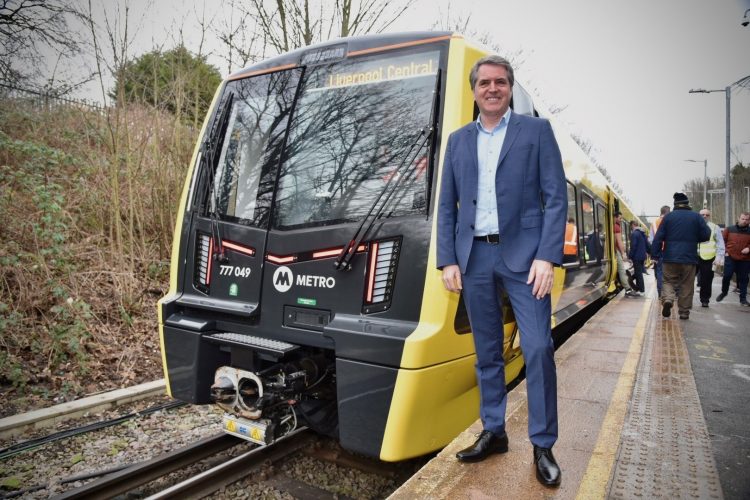
Increasing the number of trains on a regular basis at Sandhills also presents huge cost and logistical challenges. Merseyrail is constrained by the number of trains available although the Combined Authority does have the option to add to the 52-strong train fleet it recently purchased for £500m.
But a much bigger challenge is on the line itself. Merseyrail’s track and signalling is operated using a Victorian era analogue system. Across the UK Network Rail is slowly rolling out the European Train Control System (ETCS).
ETCS is a digital system that replaces physical lineside signals with in-cab computer screens and continuously transmits a ‘movement authority’ (how far and how fast the train may go) plus track data (speed restrictions, gradients, etc.) directly to a display screen in the driver’s cab.
Full implementation takes away the reliance on drivers to visually observe trackside signals. Reducing the capacity for human error allows an improved safety margin and therefore allows extra capacity to run trains closer together.
Current priority for ETCS is major inter-city or London commuter lines. Local networks such as Merseyrail would be seen as a lower priority. Even if Merseyrail was to get it the cost would be upwards of £200m.
And the disruption during its installation would be considerable. Lines would have to be closed for extended periods, there would be extensive testing, training for drivers and other staff as well as trains being taken out of service to be adapted.
ETCS for Merseyrail at some point will be inevitable but is unlikely to happen any time soon.
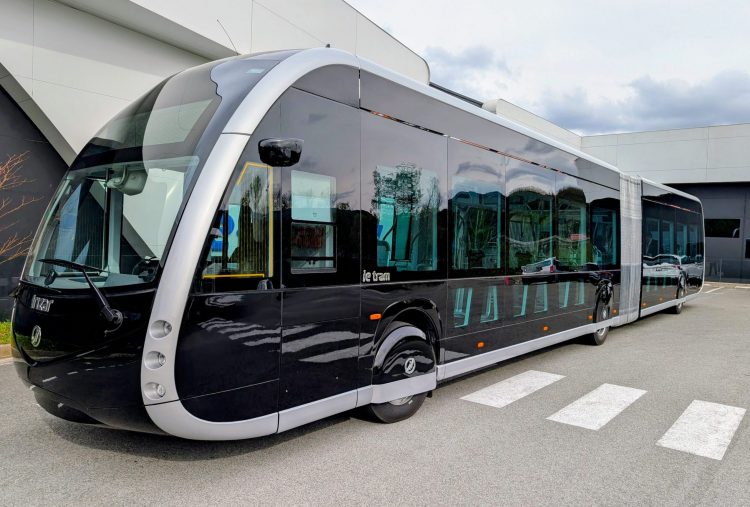
In 2028 Steve Rotheram will introduce his Glider vehicles linking the city centre with both the Everton and Liverpool football stadiums as well as Liverpool John Lennon Airport.
These articulated vehicles can carry around 30% more passengers than an average double decker bus. They look like trams but have wheels and are designed to operate on roads, running in dedicated lanes.
They also have three sets of double doors, allowing people to board and alight much more quickly, reducing the time spent at stops. Since the Glider network began operation in Belfast in 2018 it is estimated it has replaced more than 2.5m car trips.
Critics have dismissed the Glider as a “bendy bus” but Mr Rotheram is hopeful they will make a real impact on matchdays at both the Hill Dickinson and Anfield.
Comments are closed.