
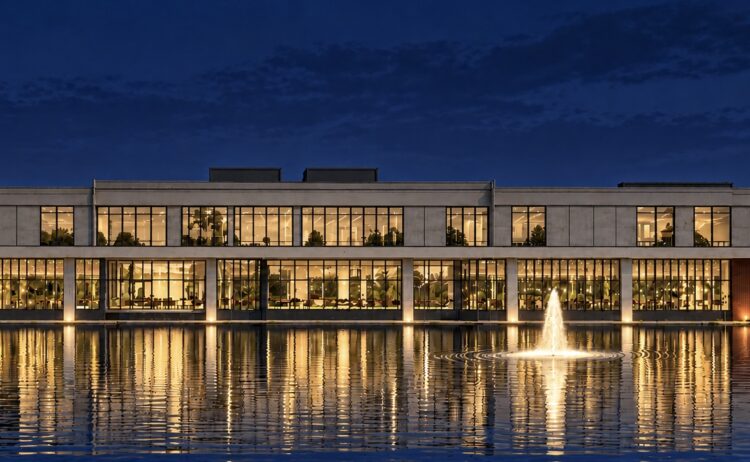
Completed in 1963, a Grade-II listed former canteen for workers at St Helens glass giant Pilkington is set to be transformed into a £6m residential complex. Tony McDonough reports
Developer Nicholson Group has submitted a planning application to convert the canteen block of the former Pilkington Glass headquarters in St Helens into new homes.
Nicholson Group chief executive Paul Nicholson wants to create 45 new apartments in the Grade II-listed building located within Alexandra Business Park. He said reaching the planning stage was a “pivotal moment”.
Monitored nationally by The Garden Trust, the modernist site was designed by renowned architect Edwin Maxwell Fry (of Fry, Drew and Partners) between 1959 and 1963. It is regarded as one of the country’s finest surviving greenfield corporate headquarters.
This project, says Paul, presents “a unique conservation challenge and an extraordinary opportunity for adaptive reuse”. A number of the apartments will offer south-facing views across a private lake, set within a registered historic park.
“Our submission has involved preparing the framework for how the property can be transformed, balancing the preservation of its protected mid-century heritage with forward-thinking commercial and community utility,” explained Paul.
“We have an affinity for tackling challenging heritage projects, and we have an excellent track record in delivery. This is a once-in-a-generation opportunity to revitalise an iconic building in an extraordinary setting.”
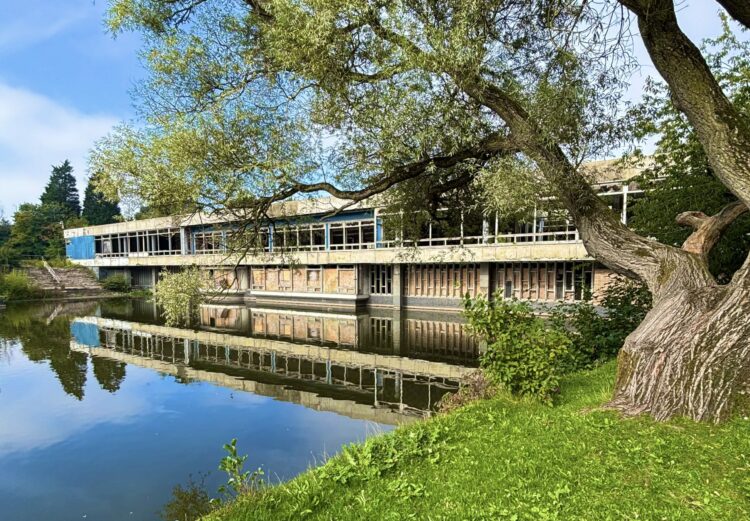

In late summer Nicholson Group completed the internal restoration and conversion of the historic Radiant House, also in St Helens, into a residential complex. Called Nicholson Point, the scheme offers 14 apartments in the centre of the town in what was once the headquarters of the Gas Corporation.
READ MORE: Martins Bank Building’s owner submits new plans
On this latest scheme Paul added: “Unsurprisingly, every time we are at the property, so many people from the local community share their stories of when either themselves or relatives worked at the Pilkington complex and they are genuinely thrilled to see the building being saved.
“Our ambition is to give the former Pilkington canteen a sustainable future as 45 homes, preserving the architecture and its relationship with the water and landscape. This is a place that deserves to be brought back to life, with its identity intact.”
Comments are closed.