

Liverpool developer Legacie has already delivered 2,500 new homes in Liverpool with a further 1,650 in the pipeline and founder and CEO John Morley tells LBN the sector deserves more credit for its economic contribution. Tony McDonough reports
Founder and chief executive of Liverpool developer Legacie, John Morley, has told LBN about his frustrations with local and central Government and the unfair negative image the sector sometimes has.
In the last few years Legacie Developments has delivered multiple residential and mixed-used schemes in and around the city centre. It has already built 2,500 apartments with further 1,650 in the pipeline.
In an interview with LBN, John said he is proud of what he and his team have done in Liverpool and believes the development sector as a whole deserves more credit and needs more support from both local and central Government.
“I dislike the perception some people still have of the industry,” he said. “Many don’t fully appreciate the positive impact development has on everyday life.
“As a sector, we need to do more to communicate the benefits we bring – whether that’s creating jobs, supporting local supply chains, contributing to economic growth, or regenerating rundown areas.
“These are achievements that should be recognised and celebrated far more.
“There are also obvious frustrations around bureaucracy and delays within the planning system. Developers constantly hear calls from national Government for more development and increased housebuilding, but too often local authorities don’t seem to share that same ambition.
“That disconnect can make progress unnecessarily difficult.”
An early interest in the built environment saw the young John enrol on a quantity surveying course at Liverpool John Moores University after leaving school wanting to “make an impact in my home city”.
Through major schemes including Parliament Square, The Gateway, Central Park and One Park Lane, Legacie has become synonymous with large-scale regeneration and major residential development. As well as Liverpool the business is also building elsewhere in the UK.
But Liverpool remains John’s passion. He explained: “Legacie is, undeniably, the leading developer in Liverpool at the moment.
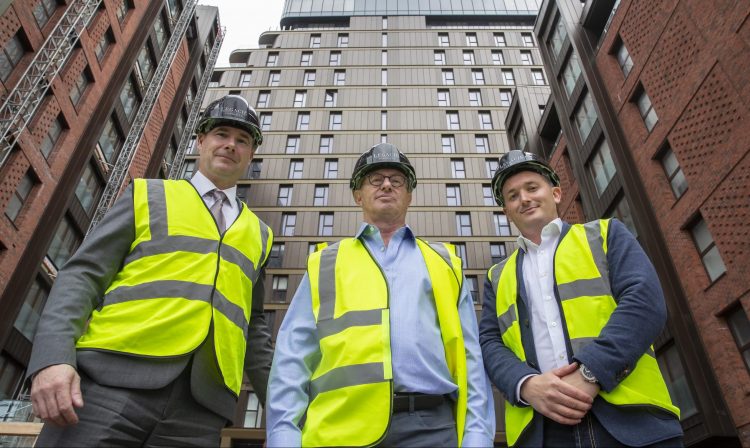
“Out of the seven tower cranes currently active across the city centre, five of them are delivering Legacie schemes. We’ve just topped out on The Gateway, our largest development in the city to date.
“The Gateway will deliver over 650 homes across four towers and will transform an under-utilised part of the city. We’ve also just reached practical completion on a scheme, Central Park, that we have supported Nexus Residential on.
“Central Park has transformed an abandoned brownfield site-which had become a magnet for antisocial behaviour and urban decay into a modern, high-quality residential village.”
John addressed one of the major challenges currently facing the property industry – the Building Safety Act 2022.
Introduced by the Government following the Grenfell disaster in 2017, the Act has strengthened regulations for building design, construction, and management, particularly for high-rise residential developments.
In April LBN revealed that another Liverpool-based Downing Construction had seen annual pre-tax losses widen to £8.7m as it grappled with the extra costs imposed by the new legislation.
“The Building Safety Act is encouraging higher standards across the construction industry,” said John.”At the same time, it is bringing significant challenges and additional cost implications that increase development costs.
“We’ve also encountered delays as the sector adapts to the new requirements. These are issues currently affecting construction companies right across the industry.”


According to John, the most compelling opportunities aren’t necessarily confined to a single geography – they sit “at the intersection of shifting demographics, affordability pressures and evolving lifestyles”.
He added: “Improved connectivity, hybrid working and relative affordability are driving sustained inward investment in inner-city areas such as the Baltic Triangle.
“The opportunity in this part of the city lies not just in residential delivery, but in creating complete, mixed-use environments that retain talent and attract employers.
“That is why I’m passionate about delivering disciplined placemaking across the Legacie portfolio, as opposed to just focusing on volume-led expansion.
For me, the next wave of opportunity isn’t simply about building higher; it is about building smarter – integrating flexibility, wellness and operational efficiency into new environments.”
John is also calling for improvements to how Section 106 contributions are spent. These are funds paid by developers to local authorities for improvements to the surrounding environment. They are often a condition of planning consent.
However, John believes there needs to be changes to how Section 106 contributions are regulated, distributed and ultimately spent.
“It has been estimated that more than £8bn in developer contributions, including the Community Infrastructure Levy, goes unspent each year across England and Wales. That shouldn’t be happening,” he said.
“There needs to be a clearer and more transparent process to ensure these funds reach the places and communities they were intended to support.
“When used effectively, these contributions can have a hugely positive impact on local infrastructure, public spaces and community facilities, so it’s important that the system delivers on that promise.”
READ MORE: £2bn fund to kick-start Martins Bank project and Pall Mall
He is also proud of the work Legacie does directly for the community. The firm’s in-house programme, Second Chance Scheme, provides employment opportunities to ex-offenders. And the Legacie Foundation is committed to improving the lives of local people and communities.
John says he wants Legacie’s schemes to make a positive contribution to the fabric of the city: “Everyone working in the built environment has a direct impact on the identity of our cities and regions.
“We still admire and talk about buildings constructed in the 1800s, and what we’re doing today contributes to that legacy for future generations. It’s rewarding to be part of shaping places that will hopefully stand the test of time.”
Comments are closed.